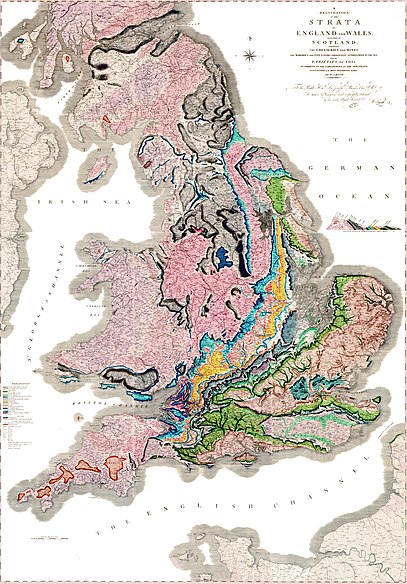
Dear William Smith,
First and foremost, I must apologise for this huge delay in writing to you. Apparently, grad school means a huge amount of work (why wasn't I told?!!), and I've been getting to grips with my rather intensive timetable.
It appears this week has been a good one for maps and such things cartographic. Not long ago, I paid a visit to the National Archives in Kew, in search of some much-needed stimulation for my research. I should have been pouring over musty old documents centered on the subject of personal hygiene in the eighteenth century but I couldn’t resist a quick look at the Archives extensive collection of maps. I sneaked a few cheeky glances at the sort of maps that readers were studying – and saw some beautifully aged and hand drawn numbers, that I am sure that you would have almost melted over.
Whilst I can definitely appreciate the aesthetic qualities of old maps (including the wondrous scent that they emit – they smell like history), I’m not sure if I have the attention span that maps deserve, to be properly studied and dissected. Even with contemporary maps, like the A-Z (possibly the most reliable and simple form of finding a route), I rarely look at. My London A-Z lies discarded in the boot of my car whilst my TomTom takes pride of place, right next to me attached to the inside of the windscreen. I don’t even have to look at the TomTom screen to view the map – he (off the trail here but I’ve always wondered if a machine can be gendered?) reads out the directions to me. Lovely chatty TomTom. Hmmm…maybe that’s why my map reading skills are so shoddy?
Today, I found this quite cool interactive map on Old Bailey Online however, that you might find quite interesting:
It shows an 1827 survey of London and you can cleverly locate specific place names that appeared in trials at the Old Bailey between 1674 and 1834. I quite enjoyed looking up the crime hotspots of the age and thinking about those areas in relation to the context of the present.
Off the topic of maps, I really really love that beautiful idea that you mentioned in your post – your eyesight aspiring to act as this tangible kind of letter-opener, in order to separate the elements of the sky and the sea, and finally view that intermediate space. That is really beautiful, dude. No wonder you’re a poet. It really got me thinking about eyesight en generale.
I went on another Tate Modern pilgrimage last week, this time visiting the John Baldessari show. I love Baldessari. A lot. Although his work is often reduced to being described as purely challenging the banality of art, I think his stuff is pretty good and there is a certain depth to the aesthetic of his work, which is largely ignored and not discussed. Don’t scroll down to the image just yet but perhaps my most loved Baldessari piece is Throwing four balls in the air to get a square (best of 36 tries) from 1974. A smattering of bright red balls in an expansive Californian blue sky, with a few tropical palm trees. Now scroll on further and inspect the image.

Although much of his work might have rather simplistic (or supposedly simplistic) concepts behind them, I think they are rather beautiful. There is something about these photos that appeals to my taste and makes me feel immediately cheered. I thought about possible reasons for this for quite a while. It could be down to nostalgia; I spent a lot of my childhood in California and I have fond memories of just lying on the beach and staring at that blue sky. I may only like this piece because of the title and the idea that something so folly, such as thirty-six attempts of throwing balls in the air in order to capture a square shape, has broken through that canonical seriousness of art. My love for this Baldessari work could be entirely arbitrary. I couldn’t put my finger on what was so attractive to me about this piece until I attended a truly engaging seminar, simply entitled ‘Colour.’
Let us ponder that age-old question of how one would describe colour to a blind person? How could we describe the Baldessari piece, where the majority of its composition is purely formed of that blue colour? I believe that it is that blue which fosters the aesthetic beauty of this piece, so its importance is undoubtedly imperative. How would you describe that blue to a blind person? The seminar left this question pretty much untouched and I have been unable to think of a satisfactory answer. Obviously you can relate colours to sensory experiences – yellow is acerbic like the taste of a lemon, for example. But I really struggle with trying to describe this blue in the Baldessari. It’s just stunning. And I’m not sure if I could cope, if I could never see this blue again.
Whilst the majority of art is only exclusive to the viewer with sight, I began thinking about what is out there in our world, which is only exclusive to the viewer without sight. A blind person cannot experience the colours in the Baldessari, like I can…so what can a blind person experience, that I cannot. And then I remembered this badboy:

This magnetic tray was designed by a contestant on the recent BBC show, Design for Life. If you didn’t watch it, you probably heard about it. World-renowned product designer (and a bit of a cuckoo, in my opinion), Philippe Starck, was on a mission to find a designer who could breathe some new life into the apparently stale, British product design market (Starck believes that there has not been a new national design aesthetic since Conran opened Habitat in the 1960s…hmmm). One contestant, who particularly stood out to me, was Mike Cloke. A recent University of Brighton graduate, Cloke ended up being a finalist in the Apprentice-style competition. He didn’t end up winning but I really thought he should have. With blind consumers in mind, he designed this rather impressive looking magnetic dinner tray, complete with coordinating tableware accessories. After dining in complete darkness, he understood the difficulties facing the blind, when it came to something as important as a eating a meal. Essentially, it is a relatively simple idea and lo-fi form of design, but why hadn’t there been an earlier form of this tray in the history of product design? It’s terribly surprising to see a truly new invention on the market today, especially when these inventions are being designed by talented people, of around the same age as us. Did you know that copyrights were primarily invented, not for the protection of designs, but to inspire people to invent new things?
Righto, now from high brow to Channel Five-esque low brow. I’m going to mix things up a bit and change my namesake, from the beloved Derrida. I have been indulging in some seriously bad, car-crash television recently, mostly in the form of The City – a pseudo reality show based on some Cali girl (Whitney Port) trying to make it in the hard edged fashion world in New York City. Oh god, I cannot believe I’m writing about this crap but it’s seriously addictive, almost as bad as crack. Anyway, Port works for this fashion PR company called People’s Revolution, which is headed by this woman, Kelly Cutrone:
Excuse the rather long running time, but isn’t Cutrone great?! She’s straight talking and perhaps the ultimate fashion badass. I secretly aspire to be a bit like her, down to the all black wardrobe (which I am currently cultivating), and that whole nonchalant ‘I don’t give a fuck, motherfucker’ thing. She also understands that fashion is, ultimately, a fleeting and completely arbitrary thing. Amazing stuff.
Kelly Cutrone xxxxxxx
p.s. I came across this random image whilst surfing the net for wedding-related things (I might be more obsessed with your wedding than you are!), and thought that you would appreciate this. It’s ampersand related!

p.p.s. I ordered Ingold’s ‘Lines’ and am eagerly anticipating its arrival. He has some very interesting ideas on materiality. I might invest in this baby too:
http://www.nytimes.com/2009/11/29/books/review/Schiff-t.html?_r=2
I love anything Faulkner related.