
I'm afraid I may have as many questions for you as I have answers/responses/meanderings. It must be because you've started us off so well, from a place of focus and specificity, and that allows me to be a bit more all over the place. It would be interesting to think about the changes in the skill of letter-writing - it was a skill once wasn't it? 'Jane is ever so good at writing letters...'.
As an events organiser, this will be a challenge because I'm wired to immediately view things from above, and work out what goes best where - imagine my mind as me trying to move things about like Tom Cruise in Minority Report. I'm also wired to put things into note form and (ugh) bullet points. I don't want to always think like this, it can be quite draining and can take the spontaneity out of things. So I have consciously made a decision to not do this, and will simply take joy in rambling. I have also consciously decided that I am writing this for you, a bit for myself, and don't want to worry about anyone else.
'Rambling' itself is a good word for how I want to write, since rambling, as a walker, is definitely a happy state for me.
I have been to the Musée D'Orsay once, in 2005 I think. I don't remember if there was a temporary exhibition. I do remember stumbling about, looking for paintings I recognised from our studies at Sixth Form at the time. You're right - it did feel like a train station, and that's why I like it. I like that the space is capable of doing that. But I don't think that its train station-ness is perpetuated by its inner workings of curation. I like to think it is an inbuilt expectation, a psychosomatic response to a highly specific dimension of space; surely there is a reason that my bodily memories of it are those of stumbling, jostling, snatching details, getting 'dragged along' as you said. It's its own A to B. This suggests a route, but I remember that the network of ceiling-less rooms seemed basically without direction, their only coercion was maybe to make it seem like there was a lot to be got through, creating that kind of urgency.
About the whole taking photographs in museums/galleries thing, taking out the obvious consideration that certain artefacts are sensitive to light, why are some places so relaxed while others so anal about this - can the only argument against taking photographs be copyright issues (and sensitivity to light etc), and if so, why do some places not bat an eyelid? Very confusing. I took some photographs of some Susie Cooper pieces at the V&A a couple of weeks ago, which I only did because I saw that other people were clicking away quite freely.
Back to curating and routes through space, regarding the Healey exhibition, it was important to create a very straightforward throughflow, as InQbate as a space in its entirety is not huge for retrospective exhibition purposes. BUT, you could go in either way, and both took you from theme to theme in a way that could work and that was easy and educational. We pared down his life into three 'legacies' or 'faces': his private, home life, the family man; his political, travelling, accountable life, the politician; his public, media-focused life, the personality. Each part featured things like film clips, interactive furniture, timelines, and could easily overlap, using his photographs as go-betweens. Because the exhibition was essentially about a person and his life, the route allowed you to consider him as one (everyone has different faces for different cirumstances/environments/recipients) - it didn't turn him into a group of artefacts (although I'm sure there are curators who could do that well).
I think that when things are separated, as you've described in the Art Nouveau exhibition, it is certainly regimented to make you follow a very exact route. Maybe for the purposes of making it seem 'bitesize', you take in information in divisible doses, it is to the benefit of your memory of the content, rather than your experience of the journey. I think if you are going to do it that way, especially if you are incorporating a great deal of objects, I think you should really go for it, treat the objects as objects, as evidence, as jewels, because they are being celebrated and showcased (of course the V&A rules at this). It should be clear that these are special, particularly if they are everyday objects. If they are everyday objects that have been taken out of their contexts, there's no point pretending that they are in their contexts.
As for the mixing of object formats, I am a big fan of this. And it really can work in a lot of ways according to the place that is housing things. I finally went to Pallant House Gallery in Chichester a couple of months ago, and they totally rock mixing things up as if it's the most natural thing to do in the world. They just quite simply don't have a problem with putting 15th century panels with 60s portraits (I can't remember if this combination actually occurred, but that sort of thing), in a way that some stately home might, but it's still a light and airy gallery format, well connected to its modern extension.
I think it's very difficult not to like Art Nouveau - it's definitely brought down to us as a style and not a movement, it's all about those lines and borders, and formal elements interrupting and complementing each other. I like it because when I see it I think of typography - it is simply serifs gone ecstatic, like notation. So using music seems appropriate as part of the experience. (I love this font by the way) I don't think the combination of audio with visual is revolutionary, I do think it's the way it should be, it's a gesamtkunstwerk thing, giving things a real 'feel' and texture. I remember in Christian's Germany course in the second year, there was a piece of reading that mentioned an 1890s group of artists who invited visitors into a series of room installations, complete with smells and the accompanying audible thoughts of the artists themselves (paintings finished only in the mind). It has happened, I think it just takes time and skill for curators to do it well - if it made you feel it was revolutionary, than the job must have been executed well! I think the way that this practise expands is entirely dependent on how the meanings behind the role of the curator expand (I think 'curator' still isn't in the OED).
They are the best kinds of exhibitions. Just like books, the interdisciplinary types make the best reading. I haven't read it yet, as it was a present to my Dad that I spotted and knew he'd like, but see Lines by Tim Ingold. Saw it in the Anthropology dept. of Heffers - must have been difficult to decide where to put it!
I think there is a fashion growing in curating and certain tastes in objects that could be very interesting, and could be a great way to test curator creativity. There's a lot more interest in steampunk, taxidermy, vintage clothing (of course) - things that are nostalgic and actively inhabit a sense of nostalgia. A lot of these tastes can be attributed to a friend of mine who is curatorially-minded, who dreams of cabinets of curiosity, and overloading spaces (domestic ones) with 'stuff' - why wouldn't someone be thrilled to behave as a ghost, and see everything with a sense of desire, a desire to finger things, to be closer to them, to inhabit an empathic transference of environment and 'feel'.
So my namesake was the first geological map-maker, whose map happened to be of Britain. He got screwed over by loads of people because he wasn't posh, and had to go to debtor's prison for a while (debtor's prison was the weirdest place - you could pretty much do what wanted, even carry on your business, it was this middle class hang out!). And of course in order to make his map, he had to walk nearly every inch of the country, most of the geology of which he was able to guess at anyway. Just finished reading Simon Winchester's The Map That Changed the World, hence inspiration. Hence, I want to get into maps and cartography.
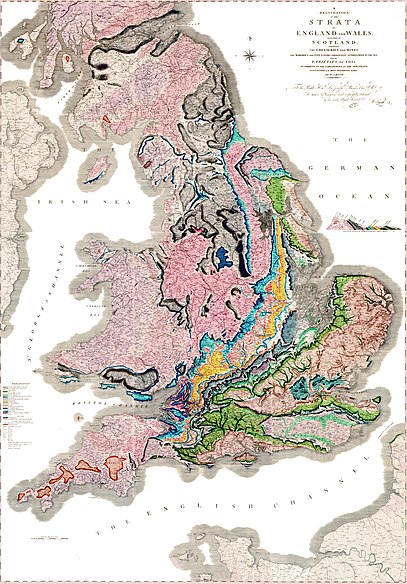
I want to think about how people picture things from different angles, what they do and don't want to see, relating their tininess to the expanse of the landscape. Maybe it interests me in the same way that theology, science and most things that involve belief interest people - it's about the mystery of what you can't see, and for me the mystery/myth/truth is in the space inbetween, the trick of distance - it's the biggest visual headfuck I can think of. When I pop down to the sea, I always have to look at the horizon, I always want my eyesight to be this tangible kind of letter-opener, easing the sea from the sky so I can get to that inbetween. A couple of weeks ago, on the train on the way back from Cambridge, I tried to draw a map of it starting from New Square (my mum's house, it's a Victorian Square pretty much in the centre), working round the city, trying to keep it navigable using my memory of the route of the river. Now, I've always been good at orienteering and all that, very good with a map, but when it comes to your hometown where you've never really had to use a map, only the collage of images in your head, weird things can happen - I ended up circling round on the piece of paper, coming to New Square again, much bigger, now turned on its head!!! I'd upended my internl compass completely. It made me so happy. It's like when you have dreams of your hometown, where new streets or buildings or environments start growing out of what you know, you create entirely new areas that, once you wake up, you know are supposed to be roughly in the north-east suburbs. I've only had one Brighton dream like that so far, and it definitely took vertical topography into account, it felt like a proper good walk.
Jacques, I'm spent, I'm putting my pen down, your turn. Expect I'll see you soon.
Fossils and strata,
William Smith.


